CNS Profiler will facilitate NeuroCart studies at other sites
A portable version of the NeuroCart® allows CHDR's validated neurophysiological test battery to be licensed to other research sites, with CHDR handling data management and analysis the data. In this interview, we speak to Dr Vasilis Exadaktylos, who coordinates this new activity.
Vasilis, you and your team are developing a new device called the CNS Profiler. What is the idea behind it?
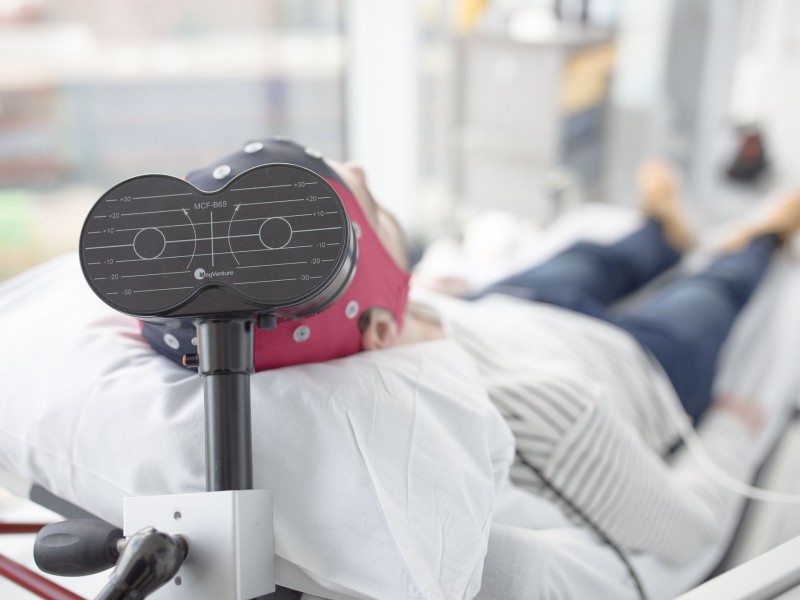
‘The idea is to build on the success of the NeuroCart, which has been at the core of our CNS research for more than 30 years now. Not only have we gained a lot of experience over the years, but we’ve also collected a lot of data. We have a NeuroCart profile of a large number of compounds and now want to put that knowledge and experience to broader use. If a pharmaceutical company wants to conduct a clinical study in a faraway country using the NeuroCart, it is currently not possible. With the CNS Profiler, it will soon be an option.’
What will the CNS Profiler look like and how will it work in practice?
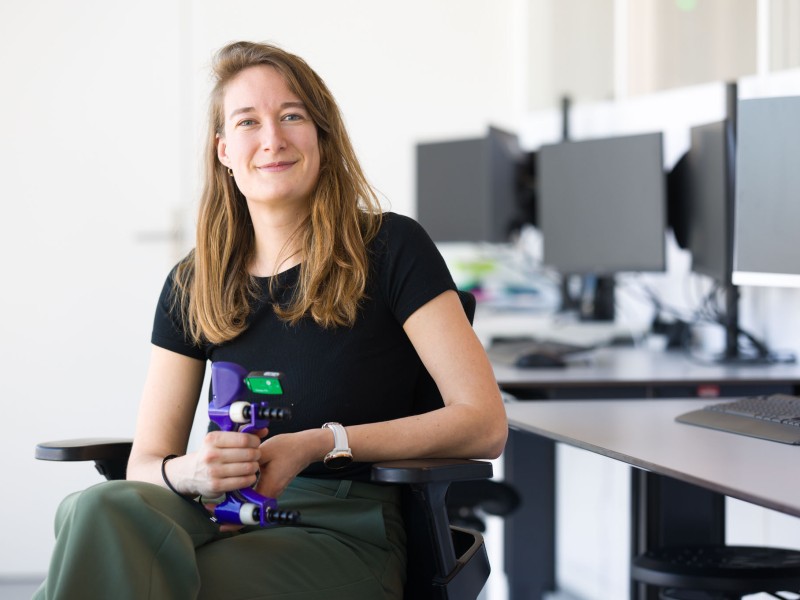
‘The CNS Profiler will be an easy-to-use device performing some of the functions of our NeuroCart. Essentially, it will be VR goggles with a tablet computer in a compact case that we can take to another contract research organisation. We will train their staff to perform the tests. All the data collected by the CNS Profilers goes to our own data facilities in a simple and secure way and will be analysed by CHDR. After all, the NeuroCart’s success is not just about performing the tests, but about interpreting the results in the context of our years of experience with the NeuroCart. At the end of each study, the CNS Profilers will be returned to CHDR.’
What progress has your team made and what are your plans?
‘Together with our colleagues from various parts of the organisation, we analysed all tests from the NeuroCart to see how we can cover most of the CNS domains that the NeuroCart monitors. This is how we arrived at a basic set of seven tests, which we then started translating into a portable setting. We simplified some operational aspects of the tests. Saccadic eye movements, for example, are measured here with electrodes next to the eye. But applying those electrodes in a standardised way requires additional training. This is how we came up with the idea of tracking eye movements with VR goggles. We determined that VR goggles are able to track eye movements with sufficient precision. In a similar way, we have already identified and solved many bottlenecks.
We are still busy adapting the NeuroCart tests to this new platform. Because these tests measure subtle time differences in neurophysiological responses, this requires meticulous work. Of course, we also need to properly validate the CNS Profiler. Thankfully, CHDR has this expertise in-house and we have the support of experienced colleagues. In the meantime, we are working with industrial designers to design user-friendly hardware for people who have no experience with the NeuroCart. It's a challenge to organise everything, but I’m glad I have a good team and the support of different teams within CHDR to tackle all the intricacies.’
Vasilis, in the past years, you were the driving force behind the Trial@home project, which aims to collect relevant data in the daily lives of study participants. Is that related to the CNS Profiler?
‘No, it’s unrelated. But my dual role does lead to misunderstandings. Trial@home is about collecting data in people's everyday environment, whereas the CNS Profiler we are now developing will only be used in a clinical research setting. Maybe in some future version, it will be possible to use the CNS Profiler in other settings as well. The Trial@home concept is now well developed and increasingly used, for example in oncology. For me personally, it’s inspiring to take on a whole new challenge in addition to our ongoing efforts to develop Trial@home.
The CNS Profiler is a complex project, with very high demands on data quality and safety. Our customers are critical, and rightly so. Drug development must deliver reliable outcomes, both for the safety of study participants and for the many complex decisions that companies need to make. So, it is important to get it right, but it’s worth the effort. I’m really excited about our CNS Profiler project, and I’m not the only one. Our team received input from many people here at CHDR, and the enthusiasm was palpable.’
Interested in learning more?
More articles from Developing methods