Ongoing innovations in recording electrical brain activity
Recording brain activity provides insight into the impact of drugs on the brain. The Biomarker Engineering and Analytics Group has developed various innovative applications to do so.
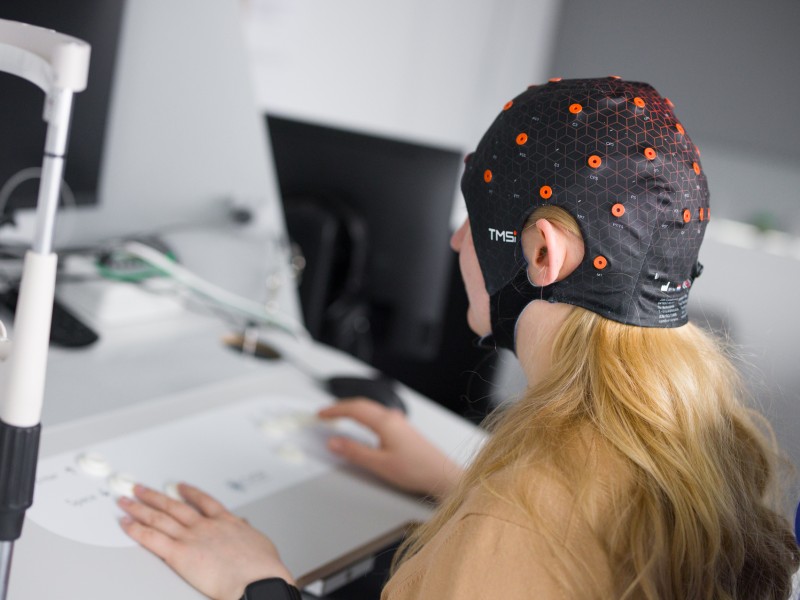
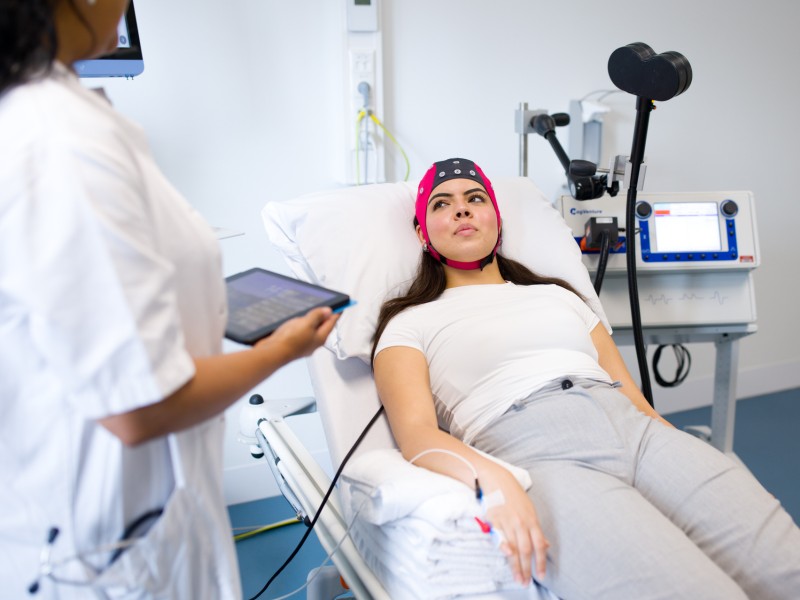
EEG is one of the standard tools for analysing drug effects in the brain. It can also be used for additional measurements, such as Evoked Potentials (EP) and Event Related Potentials (ERP), changes in the EEG that occur in response to certain stimuli. ‘We have been working on various innovations, such as more detailed analyses of the available data, measuring high gamma EEG and developing and validating additional measurements (e.g. transcranial magnetic stimulation),’ says Dr Robert Jan Doll, Associate Director Biomarker Engineering and Analytics (BEA). ‘We also took a more detailed look at the trove of EEG data we have collected over the past decades.’
Advanced statistical analysis
The BEA group has developed several new analysis techniques, including new biomarkers and methods to extract additional information from the EEG data of a study, if a client requests this additional service. Doll proudly notes that there is a growing demand for it. ‘And we are also working on new developments to further expand our analytical toolbox.’
One of these new developments is based on a statistical method to do more with the entire set of 21 EEG channels (in a regular EEG analysis of a drug trial, only 4 channels are actually used). Doll: 'This requires special analysis to avoid false positives. If you just compare 21 channels on five bands, you may seem to find effects that are not really there. Our method, a cluster-based permutation analysis, aims to reduce the likelihood of such false positives. We use statistical tools such as this to provide our customers with more detailed information about the effects of their compound on electrical brain activity over time.' The cluster-based permutation analysis was validated in 2025 and will be available to interested customers.
High gamma EEG
In drug development, there is a growing interest in the so-called high gamma range (i.e., frequencies above 60 Hz). EEG (high-)gamma rhythms are associated with cognitive activities and with the large-scale brain networks that play a role in psychiatry and in some neurological disorders.
The gamma range poses an additional translational challenge, because of muscle activity and other sources (e.g. mains activity and its harmonics). To address these problems, CHDR has special ‘high-gamma’ setups that use different methods to improve the signal-to-noise ratio. Doll: ‘We now have 10 such setups, specifically for studies in which high gamma is a biomarker for drug effects.’
Oddball tasks
The BEA team is also working on new applications of EEG in combination with stimuli or tasks and measuring the resulting ERP. An example is a roving oddball task Alissa Haj Yahya has validated and which has been applied in a study focusing on persistent effects of DMT in healthy participants. In this task, the subject is presented with a series of identical auditory stimuli, with an occasional deviating (‘oddball’) stimulus. Such a deviation leads to a specific EEG pattern, which is often measured while the participant is distracted by watching a silent movie. After a while, the response to the deviating stimulus decreases due to a learning effect. The roving oddball task is based on constantly changing (‘roving’) patterns, so that this effect can be quantified. In various studies with ketamine and psychedelic compounds, roving oddball tasks are used to study (short-term) neuroplasticity. Doll: ‘In developing and validating this task and similar EEG-based measurements, we collaborate with the groups in the CNS cluster, to ensure the optimal application in drug development studies. This collaboration, and the fact that we always work towards practical applications, is what makes our job exciting.’
Interested in learning more?
More articles from Developing methods