Expanding the applications for immunological challenge models
CHDR’s immunological challenge models—such as those involving lipopolysaccharide (LPS) exposure—are proving increasingly versatile, with new applications emerging beyond their original scope. One promising direction is the assessment of endothelial function and integrity.
‘In recent years, we’ve invested much effort into developing and validating our immunological challenge models’, says Dr Matthijs Moerland, Research Director R&D lab and Immunology. ‘This year, we’ve conducted numerous sponsored studies using these methods’.
These models involve applying a controlled immune stimulus—such as topical imiquimod, intradermal or systemic LPS, or (re)vaccination with the keyhole limpet hemocyanin (KLH) neoantigen—to induce a measurable immune response. ‘Each challenge triggers a well-defined cascade of immunological events,’ Moerland explains. ‘Now that we’ve established validated readouts, we can apply these same triggers to investigate other physiological processes.’
Vascular biomarkers
One such extension is currently being explored by Marel van Ruissen, a PhD candidate in Moerland’s group, who is working to identify vascular biomarkers using established immunological challenge models. For instance, the intradermal LPS model—originally developed to study local immune responses—can also be used to assess endothelial permeability.
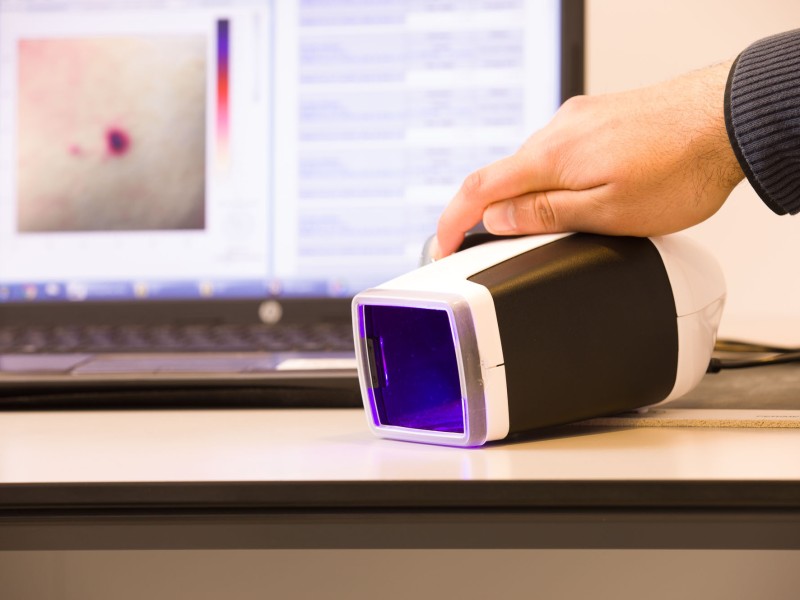
When LPS is administered into the skin, it activates local immune responses via toll-like receptor 4 (TLR4), leading to increased vascular permeability. As a result, proteins and immune cells from the bloodstream leak into surrounding tissues, causing visible swelling. This response can be precisely quantified using the multispectral imaging capabilities of CHDR’s DermaToolbox.
Targeted drug delivery with iontophoresis
Further enhancing CHDR’s vascular studies, Experienced Clinical Scientist Liza Botros employs iontophoresis—a technique that uses a mild electric current to deliver pharmacologically active, electrically charged compounds directly into the skin. ‘Iontophoresis enables us to administer small, exact doses of vasoactive substances to elicit local vascular responses,’ says Moerland. ‘Compared to topical application or injection, this method offers superior control over both dosage and distribution.’
Looking ahead: broader applications
Moerland anticipates that CHDR’s challenge models will continue to find new applications beyond their original design. 'Because we now understand these models in depth, we can interpret the results confidently across a variety of research areas. These tools can be used in the development of immunomodulatory therapies—not just for autoimmune diseases, but also for conditions like cancer,' he notes.
As the Immunology Group continues to refine and repurpose these models, their contribution to early-phase drug development is set to expand—supporting the creation of more targeted, effective therapies across multiple therapeutic areas.
Interested in learning more?
More articles from Developing methods